

A rugged vehicle tablet is a vehicle-mount computer built to run continuously inside agricultural, construction, mining and logistics equipment. CF-Device builds the VCM series (7″ to 12.1″) and the screenless TANK V2: sealed to IP65–IP67 depending on model, with third-party vibration and shock results listed on the datasheets, and powered directly from the vehicle’s electrical system. Supply voltage, operating temperature and interfaces differ by model, so treat this page as the map and the model pages as the specification. Unlike a consumer tablet in a rugged case, a vehicle tablet is engineered for one job: surviving a multi-year duty cycle while running fleet software, implement controls and safety systems.
TL;DR
- A rugged vehicle tablet is a purpose-built vehicle-mount computer, not a consumer tablet in a case
- Evaluate hardware (sealing, temperature, power, compute), software (MDM, DMS, AVM, ISOBUS VT) and the application together
- Which software a model supports, and how much of it at once, depends on the model — confirm it on the model page
- No single spec fits every industry: match the unit to the duty cycle
- This page links to seven topic hubs; pick the one that matches your question
Buyers researching this category hit three separate questions: which hardware specs matter, which software the tablet needs to run, and which application it is for. Most vendor sites answer these in isolation. This guide ties them together and links to a deeper hub for each.
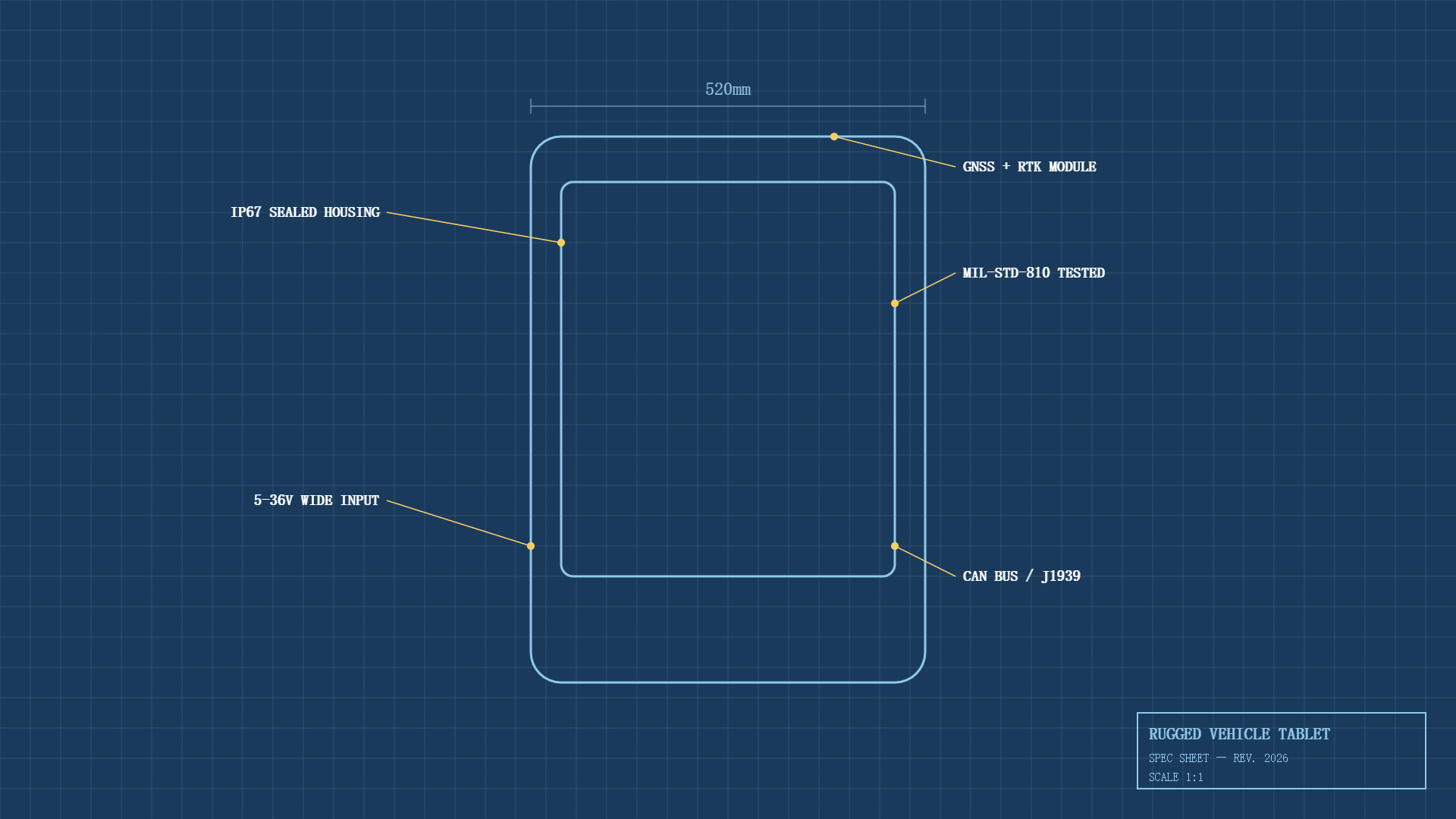
What Makes a Tablet “Rugged”?
Full breakdown: Rugged Vehicle Tablet Hardware: Complete Buyer’s Guide 2026.
| Category | What to look for |
|---|---|
| Sealing | IP65 (dust-tight, water jets) to IP67 (dust-tight, temporary immersion) |
| Durability | MIL-STD-810 test method for vibration, shock and thermal cycling |
| Operating range | A numeric range per model; CF-Device VCM units are specified to +70°C, with the low end set per model |
| Power input | Wide-voltage DC with ignition sense; 5–36V or 9–36V depending on model |
| Connectivity | CAN bus (J1939), GNSS (GPS, BDS, GLONASS; centimetre-level RTK optional), 4G/5G on selected models, Wi-Fi 6 on the VCM M10 |
| Display | Sunlight-readable brightness stated as a cd/m² figure, plus an anti-glare treatment |
| Compute | NPU-based AI vision: 6 TOPS on the VCM M10, 0.8 TOPS on several other models |
A Common Buyer Mistake
Judging ruggedness by IP rating alone. IP65 and IP67 certify dust and water protection only; they say nothing about sustained engine vibration or a cold start. Check the sealing rating and the MIL-STD-810 method together. Deeper reading: IP65 vs IP67, IP67 and MIL-STD-810 explained, CAN bus and J1939 integration and GNSS positioning.
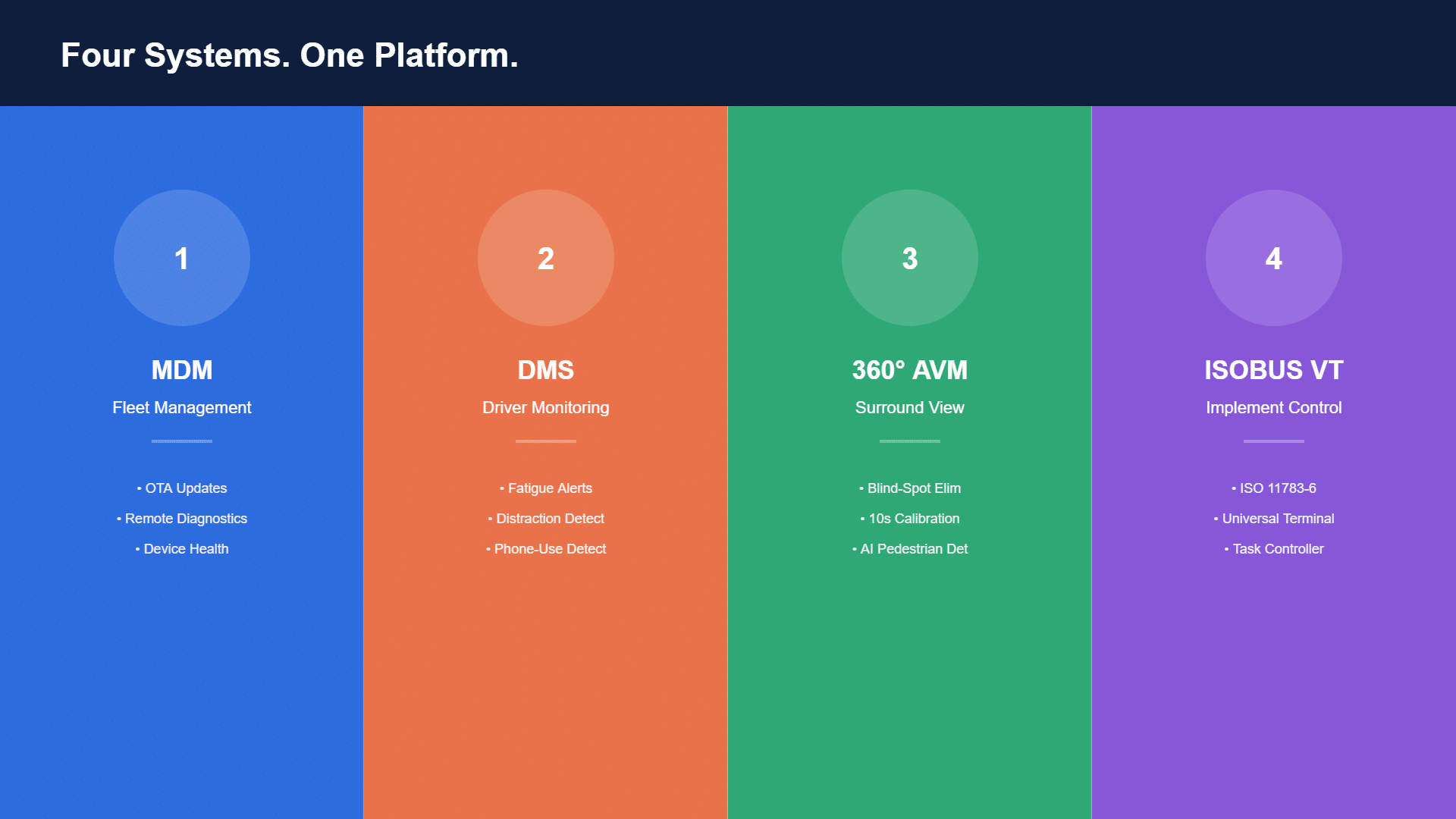
What Software Runs on a Rugged Vehicle Tablet?
Full breakdown: One Tablet, Four Systems: How MDM, DMS, 360° AVM and ISOBUS VT Work Together.
| System | What it does | Why the hardware matters |
|---|---|---|
| MDM | Remote device management, OTA updates, fleet-wide diagnostics | Runs in the background on every deployed unit |
| DMS | Real-time driver fatigue, distraction and phone-use detection | Needs a stable camera feed and on-device inference |
| 360° AVM | Surround-view camera stitching to remove blind spots | Needs several camera inputs without lag |
| ISOBUS VT | Universal implement control (ISO 11783-6) for agricultural equipment | Has to run reliably across implement swaps in the field |
The four systems are designed to share one terminal and one management interface. How many of them a given unit can run at once depends on its computing tier and camera inputs: for example, DMS in CF-Device’s range is listed on the VCM M10, which carries the 6 TOPS NPU. Confirm the model and the configuration before specifying a combination. Each system has its own guide: MDM hub, DMS, AVM 360° and ISOBUS VT.
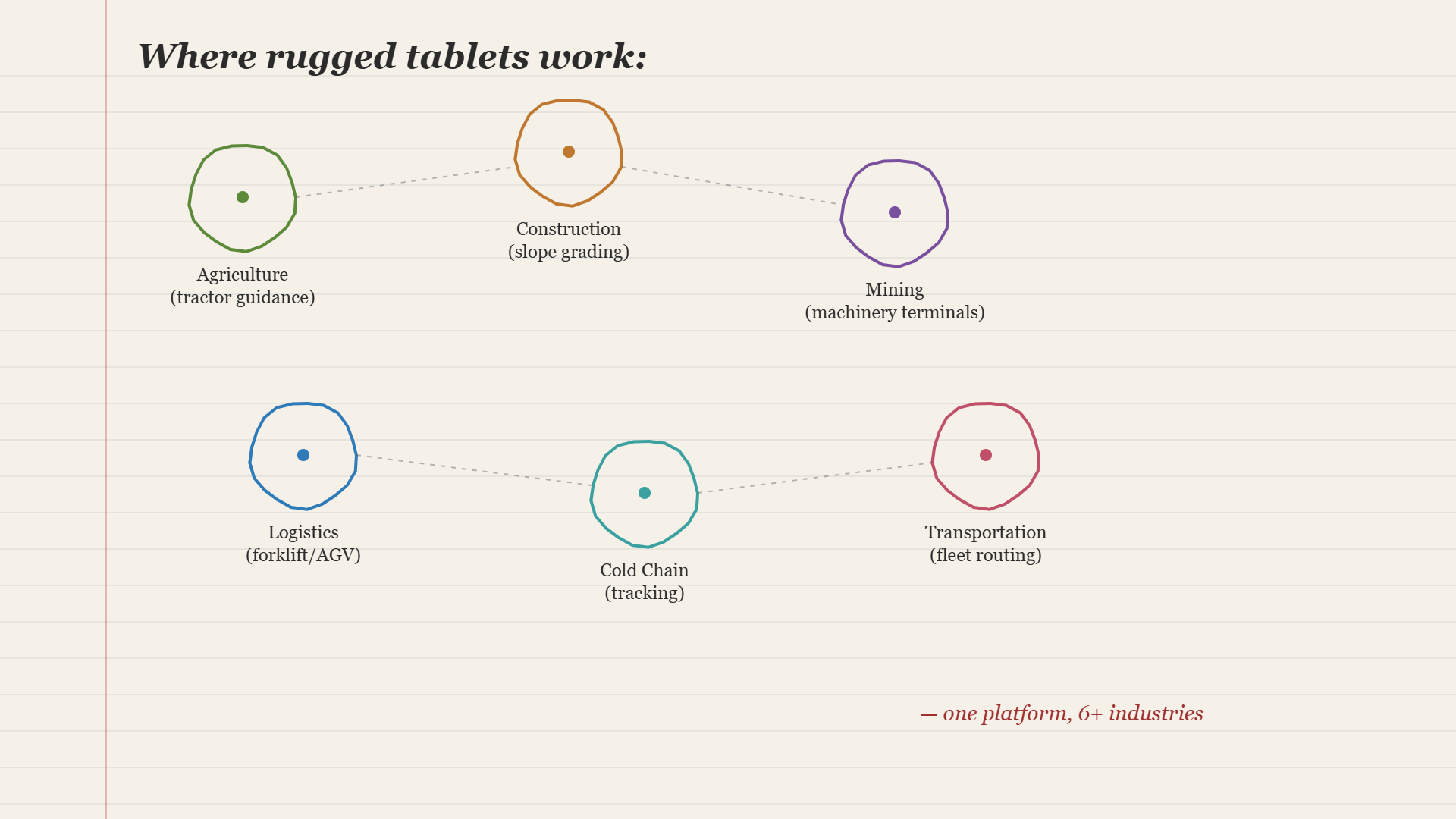
Where Are Rugged Vehicle Tablets Used?
Full breakdown: Top Use Cases for Rugged Vehicle Tablets in 2026.
| Industry | Primary use cases | Start here |
|---|---|---|
| Agriculture | Tractor guidance, variable-rate spraying, ISOBUS VT implement control | Applications hub |
| Construction | Excavator slope grading, road roller compaction monitoring | Tablet for the construction industry |
| Mining | Rugged terminals for mining machinery, gantry crane positioning | Mining terminals |
| Logistics and warehousing | Forklift and AGV terminals, cold chain tracking, fleet management | Smart warehousing |
| Transportation | Municipal fleet routing, passenger vehicle safety (DMS and AVM) | Smart transportation |
Each application stresses a different mix: precision agriculture leans on GNSS, RTK and ISOBUS VT; mining and construction lean on sealing and vibration testing; logistics leans on fleet visibility and connectivity. The right tablet is the one matched to the duty cycle.
Which Guide Should I Read First?
This page is the top-level map of CF-Device’s guides. Each topic hub below lists the articles under it.
| If your question is… | Start with | Then |
|---|---|---|
| What to buy, and from whom | Hardware buyer’s guide 2026 | VCM model comparison, Vet a manufacturer, OEM and ODM |
| Android or Linux, and which size | 10-inch Android and Linux hub | Screen size guide, Dual-OS architecture |
| Managing a fleet of devices | MDM software hub | OTA and remote control, MDM devices |
| Safety, cameras and driver monitoring | One Tablet, Four Systems | Fleet safety layers, NPU and AI vision |
| Tracking vehicles and dispatch | GPS tracking for fleet vehicles | Fleet management, Onboard computer |
| Farming and precision agriculture | Precision agriculture hub | ISOBUS VT, GNSS accuracy tiers |
| Which industry fits my machines | Use cases, field by field | Excavators, Mining |
How Do I Evaluate a Rugged Vehicle Tablet?
- Confirm the IP rating and the MIL-STD-810 test method together, not just one
- Confirm the operating temperature range is a stated numeric range that matches your climate
- Confirm the wide-voltage input range for your vehicle types; it differs by model
- Confirm screen brightness as a cd/m² figure and the anti-glare treatment for outdoor use
- Confirm which software systems the specific model supports, and whether they run together on it
- Confirm GNSS precision matches the application: standard GNSS or centimetre-level RTK
- Ask for third-party test reports behind each certification, not self-declarations
- Confirm CAN bus and J1939 compatibility with your fleet’s on-board sensors
- Confirm the OS strategy: Android for app-driven fleets, Linux for custom industrial stacks, or a dual-OS model that keeps both open — see the 10-inch Android and Linux tablet hub
How Much Does a Rugged Vehicle Tablet Cost?
CF-Device quotes per configuration rather than per list price, because interface count and positioning tier move the figure more than screen size does. The more useful question is total cost over the deployment:
- A rugged terminal costs more than a consumer tablet but is built for a much longer service life in the same cab, so the replacement cycle, not the purchase price, is where the difference lands
- Installation is a real line item: a mounted terminal needs a bracket rated to the same vibration standard and a wired power feed; budgeting hardware alone understates the rollout
- Downtime dominates: a failed terminal on a machine that cannot work without it costs more per day than the terminal did
- Parts and software support cap the real lifespan: ask any supplier for its parts and OS support window in writing before you commit
Fleets that standardise on one platform — one mount approach, one power specification, one OS image, one management console — generally spend less in the second year of a rollout than fleets running several tablet models chosen on unit price. Supplier types and what each can support are compared in distributor, vendor or manufacturer.
What Is the Difference Between a Rugged Tablet and a Vehicle-Mount Computer?
The terms overlap, but the distinction is not about toughness. A rugged tablet is a category defined by environmental certification and may be handheld or mounted. A vehicle-mount computer is defined by where it lives and how it is powered: fixed in the cab, running off the machine’s electrical system, and reading the machine’s own bus.
| Handheld rugged tablet | Vehicle-mount computer | |
|---|---|---|
| Power | Internal battery, shift-length | Wide-voltage DC from the machine, ignition sense |
| Position | Carried, docked occasionally | Fixed mount, stays in the cab |
| Machine data | External dongle if at all | Native CAN bus, J1939, ISOBUS (by model) |
| Failure mode to watch | Battery wear on continuous charge | Bracket fatigue, connector corrosion |
| CF-Device builds | No | Yes — the VCM range and TANK V2 |
CF-Device builds only the mounted category and says so plainly, because sending a buyer who needs a handheld to the wrong product class costs them more than losing the order costs us. The mounted-terminal specification sequence is in the truck computer in-cab terminal guide, and the four product types in the category are separated in the four types of rugged industrial tablet.
How Do I Know a Supplier Actually Manufactures the Hardware?
This matters after the sale rather than before it, and buyers often skip it. Three requests separate a manufacturer from a reseller:
- Quote a non-standard interface configuration — for example more CAN channels or an extra RS485 port. A manufacturer answers with a lead time and an MOQ; a reseller has to check with the factory.
- Ask for the third-party test report behind a claimed IP or MIL-STD rating, with the lab name on it, not a self-declaration.
- Ask who issues firmware and security patches. A party that forwards the request upstream does not control the software stack, or its patch timelines.
CF-Device answers the first directly: the VCM V12 PRO and S10-2 PRO offer up to four CAN channels, and further interface changes are scoped as engineering work. The full method is in rugged tablet manufacturers: how to tell a real maker from a reseller.
Why Does Scale and Track Record Matter?
Shenzhen CF-Device Intelligent Technology Co., Ltd. was established in 2018 and is headquartered in Shenzhen. Its products ship to 33 countries and regions across six continents, with hardware shipments above 140,000 units a year. CF-Device is a national high-tech enterprise, holds ISO 9001:2015 certification (certificate 00121Q310921R0S/4403), runs R&D centres in Beijing and Shenzhen, and has technical staff making up more than half of its workforce. The company reports a market share above 70% in autonomous agricultural machinery in mainland China and above 50% in excavators and mining machinery.
For buyers, the practical value of that scale is that a platform proven across many sectors and climates has already met the edge cases — extreme temperatures, mixed-fleet integration, regional certification — that a newer entrant has not. Regulatory marking such as CE and FCC is listed per model, so confirm it on the datasheet of the unit you specify. The platform-level hardware decision is in the 10-inch Android and Linux tablet hub.
Other Names for the Same Question
Buyers may call the same product a vehicle mount computer, a rugged in-vehicle tablet, or simply vehicle tablets (or a vehicle tablet in the singular); all of them describe the fixed, vehicle-powered terminals covered in this guide. A consumer tablet on a dashboard mount is not one of them: it has no vehicle power input, no sealed housing and no tested vibration rating.
Common Questions
What is a rugged vehicle tablet used for?
Fleet management, implement control (ISOBUS VT), driver monitoring, surround-view safety and real-time data collection in agriculture, construction, mining and logistics vehicles.
What IP rating does a rugged vehicle tablet need?
IP65 at minimum for dust and water-jet protection; IP67 if the equipment may face temporary immersion such as flooding or pressure washing. See IP65 vs IP67.
Can one tablet run MDM, DMS, AVM and ISOBUS VT at the same time?
They are designed to share one terminal and one management interface, but how many a unit runs together depends on its model, computing tier and camera inputs. Confirm the combination you need with CF-Device before specifying.
Is a rugged vehicle tablet the same as a consumer tablet in a case?
No. A rugged vehicle tablet has a sealed housing, vibration-tested internals and vehicle-grade power handling. A case helps with drops only and cannot add MIL-STD-810 validation, ingress sealing or voltage tolerance. See 10 inch android tablet: consumer vs industrial grade.
How long does a rugged vehicle tablet last in the field?
A vehicle-grade unit is planned for multi-year service in continuous vehicle duty, well beyond what a consumer device lasts in the same environment. Ask the supplier for the parts and software support window in writing.
Do I need centimetre-level RTK positioning, or is standard GPS enough?
Standard GNSS is enough for general fleet tracking. Centimetre-level RTK is needed for precision agriculture tasks such as autonomous guidance and variable-rate application, and is optional on selected models. See GNSS positioning.
What screen size should I choose?
Cab sightlines decide it. 7″ for compact cabs where a larger unit would block a mirror, 10.1″ as the common fleet standard, and 12.1″ where implement control or multi-camera surround view needs the area. Specify the mount against the body dimensions in the datasheet, not the screen diagonal. See how to choose the right tablet screen size.
Which CF-Device model should a first-time buyer start with?
Start from the 10.1″ class, which suits the widest range of cabs. The VCM S10-2 is the entry-level 10.1″ unit on an older platform; where a current Android version, more cameras or on-device AI matter, look at the VCM S10-2 PLUS or the VCM M10. Supply voltage and operating temperature differ by model, so confirm them on the model page.
Interested in specs or a quote? Contact our team to discuss hardware, software and deployment for your fleet.